
FM-200 Room Integrity Test
Door-fan enclosure integrity testing that proves your protected room will hold its FM-200, Novec 1230 or inert-gas concentration for the required retention time — documented in a clear test report.
A clean-agent system only works if the room holds the agent
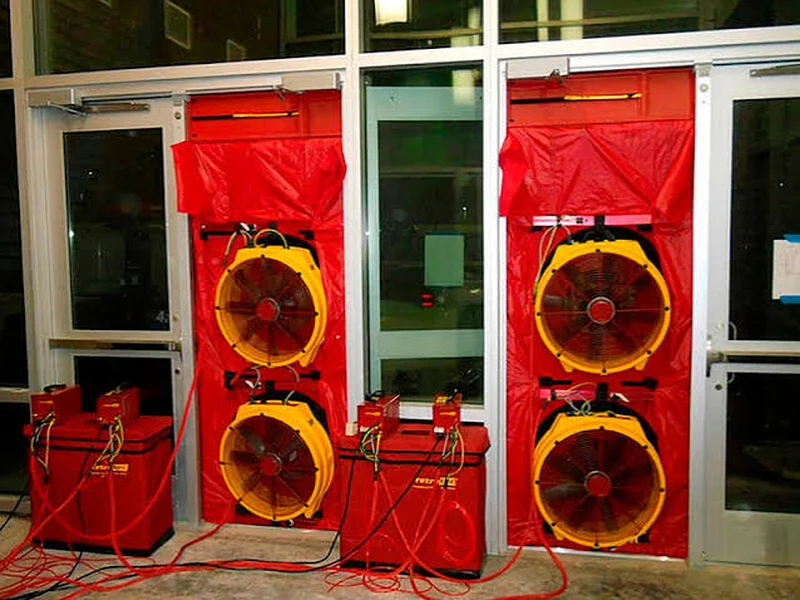
Gaps around doors, cable and pipe penetrations, ceiling voids and ductwork let the agent escape before the fire is fully extinguished. A room integrity test measures the enclosure’s leakage and predicts how long the agent will stay at design concentration — before a real discharge depends on it.
Our test verifies that, after discharge, the agent is retained in the protected enclosure for a minimum of 10 minutes at design concentration, and that the peak pressure stays within the limit the enclosure can withstand.
- Test report with retention time and peak pressure results
- Equivalent leakage area of the enclosure
- Guidance on where leaks are and how to seal them
- Retest after remedial sealing
- Testing for FM-200, Novec 1230 and inert-gas systems
What we measure and why
Agent characteristics
| AGENT | STORAGE | DESIGN CONCENTRATION | KEY CHARACTERISTICS |
|---|---|---|---|
| Novec 1230 FK-5-1-12 | Fluid, pressurised with nitrogen — up to 500 psi | 3.5% – 9% | Strong negative peak pressure — large rooms often need a relief vent. Heavier than air. Environmentally friendly (zero ODP, low GWP). |
| FM-200 HFC-227ea | Liquefied gas, pressurised with nitrogen — 360 psi typical | 7% – 9% | Negative peak pressure, lower than Novec 1230. Heavier than air. |
| Inert gases IG-01, IG-100, IG-541, IG-55 | Compressed gas | Per system design | IG-01 argon · IG-100 nitrogen · IG-541 nitrogen 52%, argon 40%, CO₂ 8% · IG-55 nitrogen 50%, argon 50%. |
How the test is carried out
- Enclosure dataWe record the room volume, maximum height and maximum protected height.
- Agent and test modelWe select the agent and the calculation model — descending interface, continuous mixing or extended discharge.
- Bias pressureWe measure the static pressure caused by HVAC and adjacent spaces.
- Pressurise and depressuriseDoor-fan testing at multiple pressure points: 10 and 50 Pa (positive and negative) to NFPA 2001, or five points from 10 to 60 Pa to ISO 14520.
- Calculate and reportRetention time and peak pressure are calculated, compared with the requirements and documented in the test report.
We locate the leaks, advise on sealing and retest — so your FM-200 or Novec 1230 room is ready for handover.
Book a testOther tests we carry out in-house
Frequently asked questions
What is a room integrity test?
It is a door-fan test of the room protected by a clean-agent system. Calibrated fans pressurise and depressurise the enclosure to measure its leakage, and from that the test predicts how long the FM-200, Novec 1230 or inert gas will stay at design concentration after a discharge. The method follows NFPA 2001 and ISO 14520.
Is any FM-200 discharged during the test?
No. The test uses fans only, so no agent is released and the cylinders are not touched.
What hold time does the room need to achieve?
The agent should be retained at design concentration for at least 10 minutes, unless the authority having jurisdiction requires a different time. The report also confirms that the peak pressure on discharge stays within what the enclosure can withstand.
How often should the room be tested?
NFPA 2001 requires the protected enclosure to be inspected at least every 12 months for changes such as new cable or pipe penetrations, altered ceilings or new doors. If changes are found that could affect leakage, the room should be retested. A test is also needed when the system is first commissioned.
What happens if the room fails?
We show you where the leaks are — typically door gaps, cable and pipe penetrations, raised floors and ceiling voids — seal them with certified fire stopping, and retest until the room passes.
Book your test with our engineers
Tell us about the system and location. We will confirm the scope, schedule and price.